Moisture remains one of the leading causes of flooring failure on concrete slabs, triggering adhesive breakdown, bubbling, and mould growth. Industry guidance often targets internal relative humidity below 75–80% before installing resilient or timber finishes, depending on the system specified. Reliable testing methods, including in-situ RH probes and calcium chloride tests, quantify risk rather than guess it. Mitigation measures such as epoxy moisture barriers and controlled drying can reduce vapour transmission and protect warranties.
Key takeaways
- Test slab moisture before flooring installation to avoid adhesive and coating failures.
- Use in-situ relative humidity probes for internal moisture, not surface-only readings.
- Calcium chloride tests measure moisture vapour emission rate and suit certain flooring systems.
- Compare results against manufacturer limits, commonly 75–85% RH or 3–5 lbs MVER.
- Allow adequate drying time; thicker slabs and limited ventilation extend drying schedules.
- Apply epoxy moisture mitigation systems when moisture exceeds limits and drying is impractical.
- Control site conditions, including temperature and humidity, to stabilise test accuracy.
Why Concrete Slab Moisture Causes Adhesive Breakdown, Cupping, and Microbial Growth
ASTM F2170 sets the upper limit for in-situ relative humidity (RH) at 75% RH for many resilient floor coverings, with some systems allowing up to 80% RH when the adhesive and flooring manufacturer permits it (ASTM). When slab moisture exceeds those thresholds, water vapour migrates to the bond line and changes adhesive chemistry. Acrylic and pressure-sensitive adhesives can re-emulsify, while high alkalinity moisture can drive pH upward; fresh concrete pore solution can measure around pH 12–13, which accelerates adhesive softening and loss of tack.
Dimensional instability follows quickly in hygroscopic materials. Wood flooring can change dimension by roughly 0.25% per 1% change in moisture content (USDA Forest Products Laboratory), so uneven moisture from below can force boards to curl at the edges, producing cupping and stress at seams. Resilient products can also telegraph slab moisture through adhesive plasticisation, leading to bubbles, edge lift, and joint peaking.
Microbial growth becomes a parallel risk when moisture persists at the interface. The US EPA notes that mould can start growing within 24–48 hours on damp materials, and many fungi thrive when local RH stays above about 80%. Once the slab keeps the underside of flooring damp, odours, staining, and indoor air quality complaints often follow even before visible mould appears.
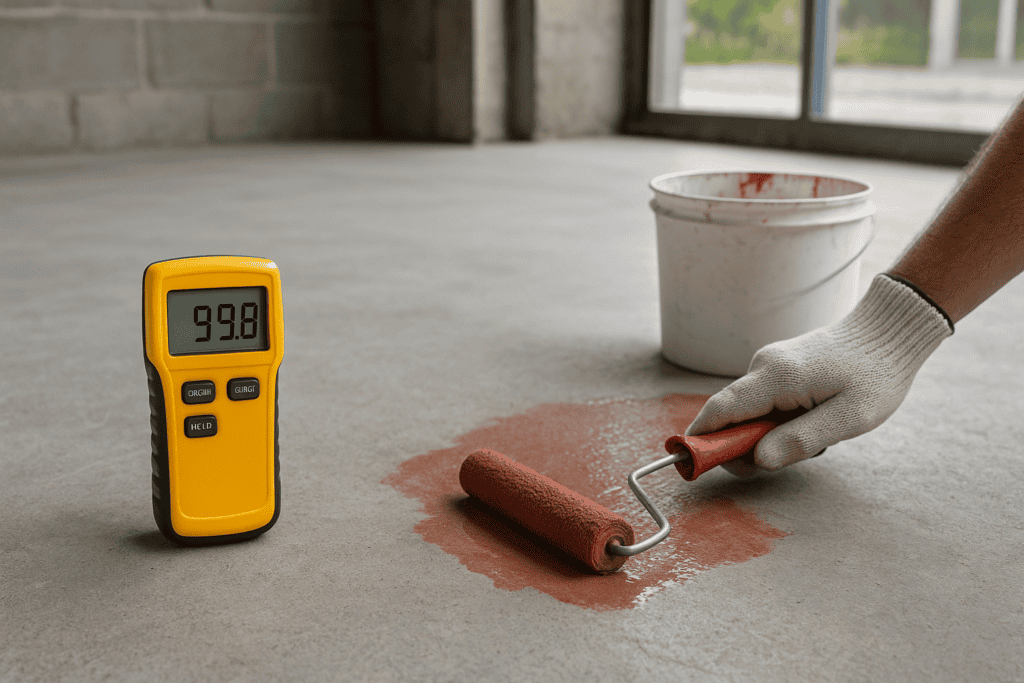
Moisture Testing Methods for Slabs: RH Probes (ASTM F2170), Calcium Chloride (ASTM F1869), and pH
A hospital corridor received new vinyl, yet seams lifted within three weeks because the contractor relied on a surface meter and skipped formal tests. A follow-up assessment used in-situ RH probes under ASTM F2170, drilled to 40% slab depth for drying from one side, and recorded 86% RH at 20 °C. The same area failed the ASTM F1869 calcium chloride test at 6.2 lb/1,000 ft²/24 h, confirming high vapour emission at the surface.
Those methods answer different questions: RH probes measure internal moisture conditions that drive long-term vapour movement, while calcium chloride quantifies short-term surface emission. A pH test then showed 11.2, high enough to stress many adhesives and primers. Used together, RH, emission rate, and pH reduce false confidence from a single reading and align test results with manufacturer limits before selecting mitigation.
On most projects, schedule RH probes early, verify with F1869 where specified, and document pH after surface preparation so mitigation targets both moisture and alkalinity.
Interpreting Test Results: Flooring Manufacturer Limits, Service Conditions, and Risk Factors
Manufacturer limits set a pass/fail threshold, while service conditions decide whether that threshold stays safe after handover. A slab can meet an adhesive limit at 20 °C yet fail once the building operates at higher temperature and vapour pressure.
| Interpretation lens | What it uses | What it can miss | Practical implication |
|---|---|---|---|
| Manufacturer limits | Published maximum RH or MVER, plus pH range | Seasonal swings and HVAC commissioning delays | Confirm limits in the current product data sheet before specifying adhesives |
| Service conditions | Expected temperature and internal RH during occupancy | Moisture drive from warm, humid air over cooler slabs | Test near operating conditions; a 5 °C rise can increase vapour pressure by roughly 15% |
| Risk factors | Ground moisture, curing method, slab thickness, vapour retarder quality | Localised “hot spots” under racks, mats, or sunlit areas | Increase test locations; ASTM F2170 requires at least 3 probes for the first 1,000 ft² and 1 per additional 1,000 ft² |
When results sit within 2–5% RH of a stated limit, treat the installation as high risk and plan mitigation. A compatible mitigation system can extend tolerance, but only when flooring and adhesive warranties allow it.
Moisture Mitigation Options: Surface Preparation, Epoxy Vapour Barriers, and Ongoing Verification
Flooring failures often start when a slab tests within limits, yet moisture rises after installation and overwhelms the adhesive bond line. When in-situ RH remains above the flooring system limit (often 75–80% RH) or MVER exceeds 3–5 lb/1,000 ft²/24 h, mitigation must reduce vapour transmission rather than mask symptoms.
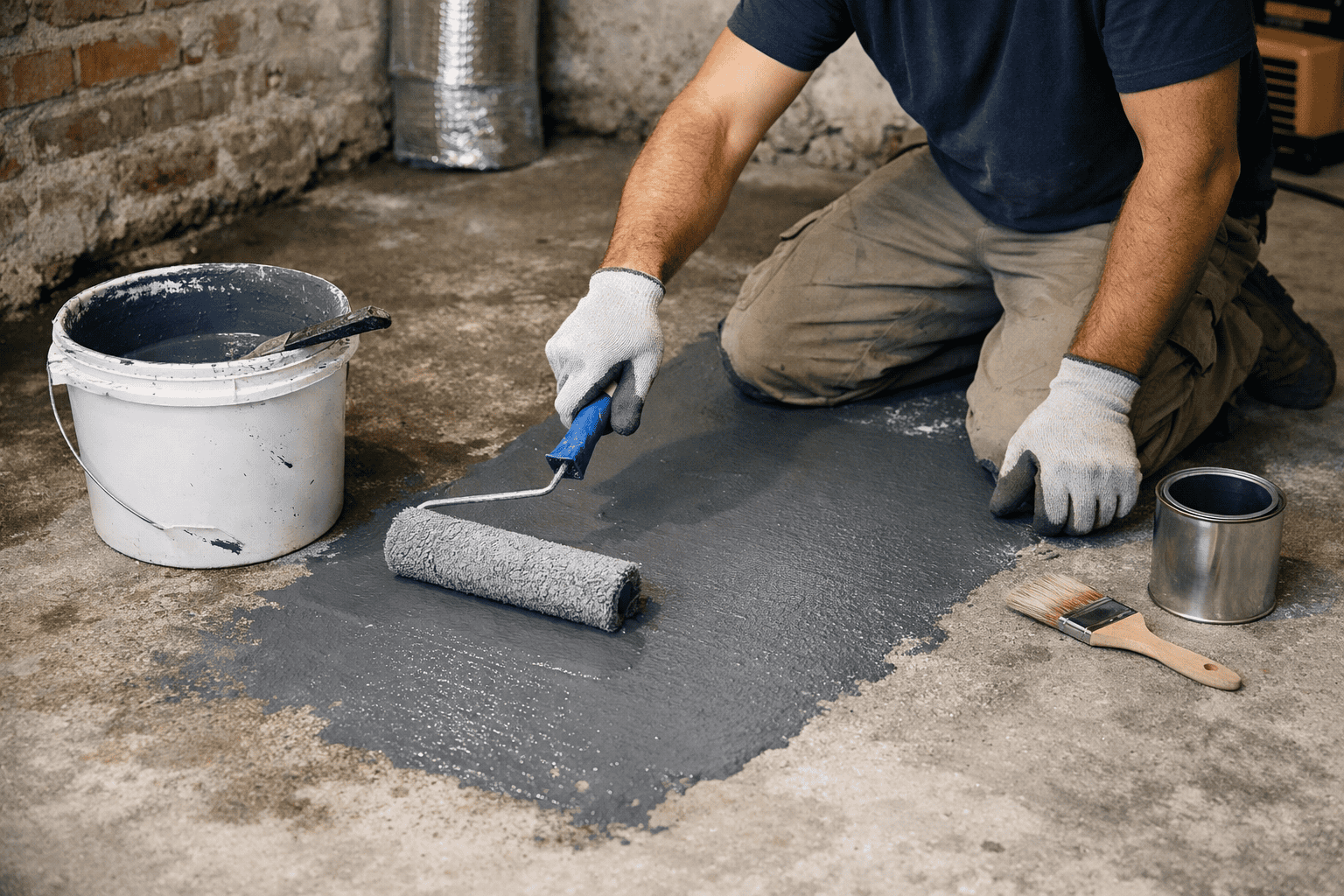
Use a controlled system: mechanically prepare the surface to ICRI CSP 3–5, remove curing compounds, and verify soundness with a pull-off test of at least 200 psi (1.4 MPa). Apply a two-part epoxy vapour barrier rated for high moisture (commonly up to 95–100% RH), then broadcast sand to refusal to secure adhesive grip. Confirm performance by re-testing RH after cure and documenting temperature and dew point during application, following ASTM F2170 procedures.
Track results with a short re-test window (24–72 hours) and retain records for warranty and handover, reducing the risk of seam lift and microbial growth.
Frequently Asked Questions
Which moisture tests are most reliable for concrete slabs before flooring installation?
The most reliable pre-installation tests are:
- In-situ relative humidity (RH) probes (ASTM F2170): measures internal slab moisture at 40% depth; many flooring systems require ≤75–85% RH.
- Calcium chloride vapour emission (ASTM F1869): reports MVER in lb/1,000 ft²/24 h; common limits are 3–5.
Use RH probes for thicker slabs and confirm with surface pH (often ≤9–10).
What relative humidity (RH) and moisture vapour emission rate (MVER) thresholds indicate a high risk of flooring failure?
High failure risk typically starts when in-slab RH exceeds 75%–80% (ASTM F2170) or when MVER exceeds 3 lb/1,000 ft²/24 hours (about 1.36 kg/100 m²/24 hours) under ASTM F1869. Many resilient and wood flooring systems specify tighter limits, often 70%–75% RH and 2–3 lb MVER.
How long should a concrete slab dry before installing resilient flooring, timber, or carpet tiles?
Allow at least 28 days curing, then verify dryness with testing. For resilient flooring and carpet tiles, many specifications require ≤75% RH (ASTM F2170) or ≤3 lb/1,000 ft²/24 h MVER (ASTM F1869). For timber, targets are often ≤65–75% RH. Drying commonly takes 3–6 months for a 100 mm slab without a vapour barrier.
What site conditions and slab design factors most commonly cause elevated moisture in concrete slabs?
Elevated slab moisture most often comes from missing or damaged vapour barriers, poor subgrade drainage, high water tables, and wet backfill. Design and construction drivers include high water–cement ratios (often >0.50), thick slabs (100–150 mm) that dry slowly, curing compounds that trap moisture, and early floor covering installation (often <28 days).
Which mitigation methods, such as surface-applied moisture barriers or epoxy damp-proof membranes, work best for high-moisture slabs?
For high-moisture slabs, two-part epoxy damp-proof membranes perform best because they tolerate higher moisture vapour emission rates, often up to 25 lb/1,000 ft²/24 h (ASTM F1869) and 100% relative humidity (ASTM F2170) when installed to specification. Use cementitious moisture barriers for moderate moisture. Avoid simple acrylic sealers; they typically fail above 5 lb/1,000 ft²/24 h.